New Study Sheds Light on the Evolution of Alismatidae
2012-04-24
Alismatidae is one of the oldest lineages within monocots. It is widely distributed in the world, and plays an important role in the systematics, biogeography of flowering plants. Previous studies related to Alismataceae have focused either on the species-level relationship, or the interfamilial relationships of Alismatidae. The disagreements with regard to the genetic relationships of this family, however, still remain unanswered. A recent research result released by Dr. WANG Qingfeng and his research group at Wuhan Botanical Garden may provide insights into this question.
Dr. WANG Qingfeng and his research group have investigated the evolution of Alismatidae based on comprehensive nuclear, chloroplast, mitochondria DNA sequences and fossil records. Their results indicated that Alismataceae originated in West Palearctic or Afrotropical area during the Late Cretaceous and Hydrocharitacedae originated in Asian area in 54.7-72.6 Ma. The intercontinental distribution of Alismataceae and Hydrocharitaceae mainly resulted from long distance dispersal, and dispersal via the Tethys seaway, land bridges and island chains. Hence, the traditional viewpoint that the intercontinental distribution was facilitated by the continent drift was challenged.
What’s more, their study also suggested that Australia had played an important role in the diversification of aquatic plants, and reappraised the phylogenetic relationships for some taxa, e.g., Alisamtaceae, Butomaceae, Limnocharitaceae, Limnocharis and Astonia.
The studies entitled “Generic phylogeny and historical biogeography of Alismataceae, inferred from multiple DNA sequences” and “Generic phylogeny, historical biogeography and character evolution of the cosmopolitan aquatic plant family Hydrocharitaceae” have been published in Molecular Phylogenetics and Evolution (2012, 63: 407–416) and BMC Evolutionary Biology (2012, 12: 30).
Related links: http://www.sciencedirect.com/science/article/pii/S1055790312000334
http://www.biomedcentral.com/1471-2148/12/30/abstract
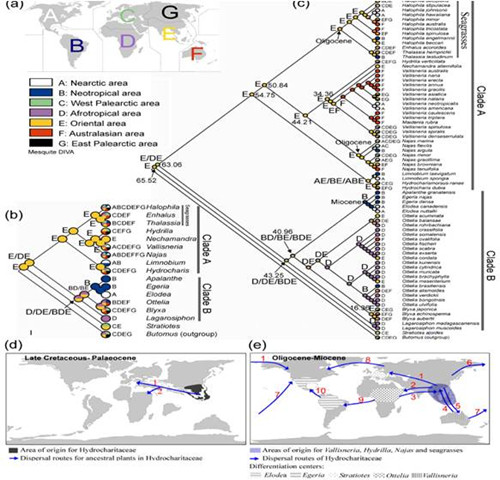
Historical biogeography of Hydrocharitaceae (a) Area delimitation in biogeographic analyses. (b) Analyses using genera as terminal taxa, and (c) analyses using species as terminal taxa. Distribution of each genus or species is indicated along with taxon names. Results of Mesquite are indicated by coloured circles; results of dispersal-vicariance analysis (DIVA) are indicated by capital letters (only the results of major clades are shown); equally optimal ancestral distributions are indicated by pie-charts (Mesquite) or slashes (DIVA). The times inferred from divergence time estimates were marked on the major clades. (d) & (e) Possible origin, differentiation centres and dispersal routes of Hydrocharitaceae (Image by CHEN Lingyun)