Forest Tree Diversity Promotes Watershed Ecological Functions, Global Study Finds
2026-07-30
Understanding how plant diversity supports ecosystem functions is crucial for biodiversity conservation and ecosystem management. Previous small-scale studies often failed to capture the complexity of natural ecosystems, especially their roles in water supply and flow regulation in watersheds.
An international collaborative team led by the Wuhan Botanical Garden of the Chinese Academy of Sciences has examined this relationship at the watershed level, a natural unit where water connects climate, soil, and vegetation. Researchers analyzed 846 forested watersheds across Europe, the Americas, and Asia. Using remote sensing data, streamflow index dataset, and more than 55,000 plot survey records from the Global Forest Biodiversity Initiative database, they evaluated how tree species richness impacts five key ecological functions: carbon fixation, carbon storage, water supply, hydrological regulation, and soil conservation.
The findings indicated that watersheds with greater tree species richness had higher watershed ecological multifunctionality, even after accounting for forest structure, climate, soil, and topography. This positive effect of tree species richness on ecological multifunctionality increased with watershed area and was regulated by climatic conditions with the precipitation as the most influential factor. These findings highlight tree diversity as an important biological foundation for sustaining multiple ecological functions at the watershed scale. Greater tree species richness may help maintain diverse microclimatic conditions, soil environments, and hydrological regimes, thereby enhancing the capacity of watersheds to support multiple ecological functions simultaneously.
This study extends the traditional understanding of biodiversity-ecosystem functioning (BEF) relationships from local plots to the watershed scale, reveals the macroecological functions of plant diversity, and establishes an indicator system and methodological framework for characterizing the Ecological Multifunctionality of Watersheds.
The related findings, titled "Ecological multifunctionality of watersheds increases with tree species richness," were published in Nature Communications. Assistant Researcher ZHANG Jiehao is the first author of the paper, and Researchers ZHANG Quanfa and ZHANG Kerong are the corresponding authors. This work was supported by the National Natural Science Foundation of China, as well as the Excellent Member Program of the Youth Innovation Promotion Association of the Chinese Academy of Sciences.
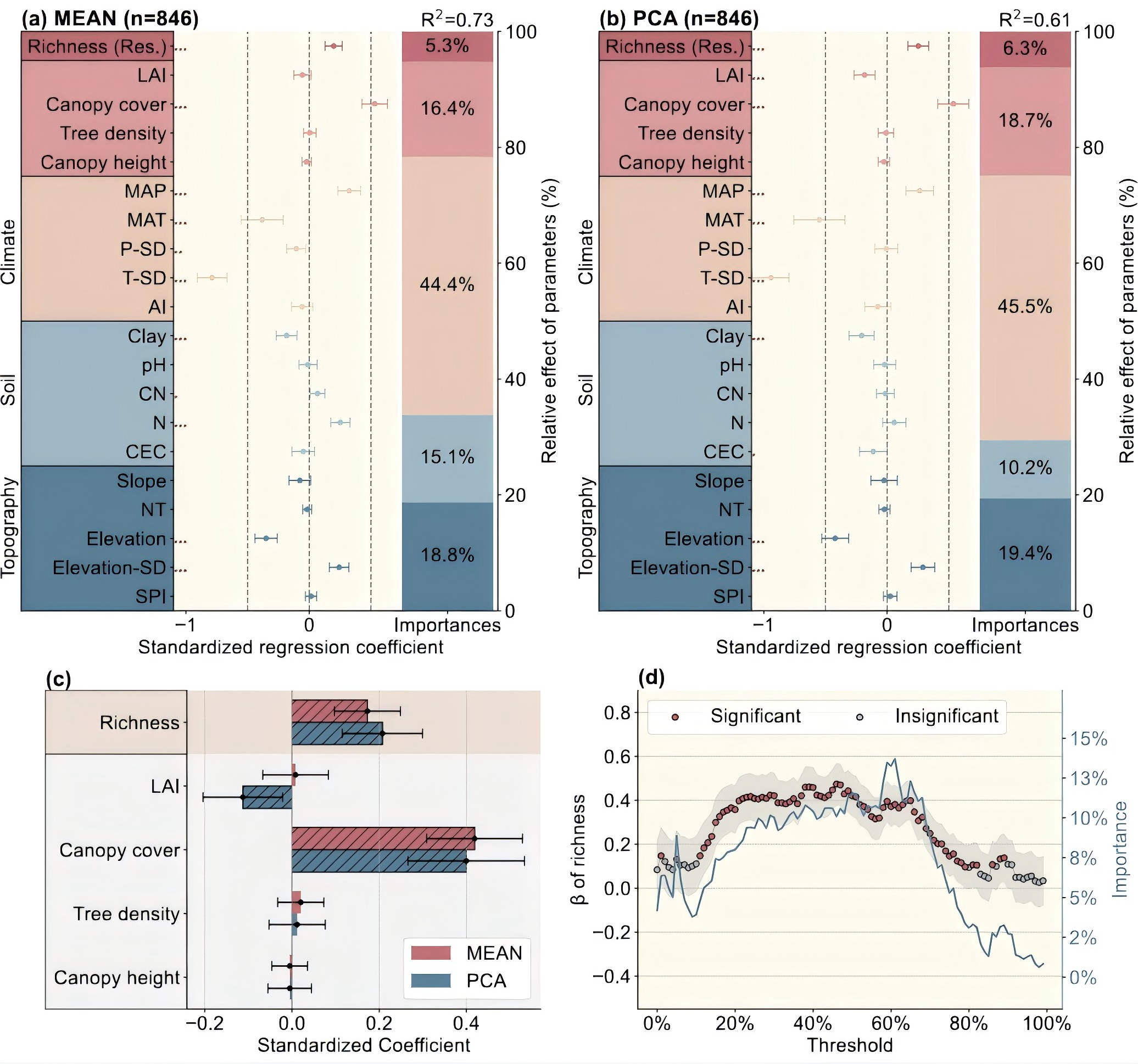
Relationships between tree species richness and ecological multifunctionality (Image by WBG)