Name:
Tell:
Email:
Organization:
Scientists Biosynthesize Anti-tumor Triterpenoids in Yeast Cells
2012-07-12
The triterpenoids “betulinic acid”, "ursolic acid”, and “oleanolic acid” exhibit various pharmacological activities such as anti-cancer, anti-HIV, and anti-microbial properties. In particular, betulinic acid has been considered as one of the most promising anti-cancer compounds just like the famous anti-tumor drug “taxol”.
Prof. ZHANG Yansheng and his Ph.D. student HUANG Lili from the Natural Product Biosynthesis Research Group at Wuhan Botanical Garden have isolated two key genes (CrAS and CrAO) involved in the biosynthesis of ursolic- and oleanolic acids from the medicinal plant Catharanthus roseus. When the CrAS and CrAO were co-expressed in yeast cells, the transgenic yeast strains showed the abilities for the de novo biosynthesis of ursolic- and oleanolic acids. The researchers were surprised to find that the CrAO was able to catalyze the synthesis of the anti-cancer compound “betulinic acid” using the lupeol as the substrate. Until now, betulinic acid is mainly originated from the bark of birch tree. It is costly to extract the betulinic acid from the tree directly. Through the unnatural combination of the lupeol synthase gene (AtLUP1) from Arabidopsis thaliana and the CrAO from Catharanthus roseus, the first bio-synthesis of the anti-tumor compound “betulinic acid” in yeast cells was presented.
The current research provided a novel approach to the synthesis of these anti-tumor compounds, which shows the possibility on the potentially industrial applications in the future. The relevant experimental data has been accepted as a publication in “Planta” journal.
Article link: http://www.springerlink.com/content/e056487141686j16/
Author contact: Prof. ZHANG Yansheng
Tel: +86-27-87617026
Email: zhangys@wbgcas.cn
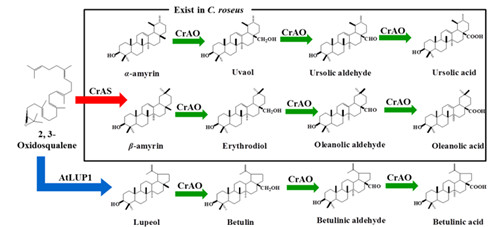
The proposed biosynthetic pathway of betulinic-, ursolic-, and oleanolic acids (Image by Natural Product Biosynthesis Research Group)