Name:WANG Yanchang
Tell:
Email:kiwifruit@wbgcas.cn
Organization:Wuhan Botanical Garden
High Temperature Threatens Red-Fleshed Kiwifruit Vibrant Color and Nutrition
2026-02-03
Red-fleshed kiwifruit, prized for its rich anthocyanins and associated health benefits, is facing a growing threat from rising temperatures. Global warming is severely inhibiting anthocyanin accumulation, leading to flesh discoloration and nutrient loss, directly threatening fruit quality and sustainable industry development.
To address this challenge, researchers at the Wuhan Botanical Garden of the Chiense Academy of Sciences used 'Hongyang' kiwifruits to simulate high-temperature stress (30°C, 35°C, 40°C, versus a 25°C control). They systematically monitored physiological indicators, transcriptome characteristics, and dynamic changes in related metabolites to reveal the impact of high-temperature stress on anthocyanin biosynthesis and stability, providing a theoretical basis for developing fruit quality regulation strategies under high-temperature stress.
The study results showed that increased temperature (25-40°C) significantly induced branch in the anthocyanin biosynthesis pathway, and the degradation rate of anthocyanins accelerated with rising temperature, shortening their half-life. High temperature promoted the accumulation of degradation products such as protocatechuic acid, while activating the expression of degradation enzyme genes like laccase and β-glucanase.
This study first constructed a kinetic model of anthocyanin metabolism in living tissue (fruit flesh), confirming that under high-temperature conditions, the metabolic flow in the phenylpropanoid pathway of kiwifruit is redirected. The combined effect of inhibited anthocyanin biosynthesis and accelerated degradation leads to a significant reduction in accumulation levels.
This achievement not only provides a new perspective for understanding plant anthocyanin biodegradation mechanisms but also lays a theoretical foundation for molecular breeding practices in fruit color regulation.
Result have been published in the Plant Physiology and Biochemistry, entitled“High temperature affects synthesis and degradation of anthocyanin in red-fleshed kiwifruit (Actinidia chinensis): pathway and kinetics analysis”. WANG Yanchang (Wuhan Botanical Garden, CAS), Olga Ivanovna Molkanova (Main Botanical Garden Named After N.V. Tsitsin of the RAS, Moscow) and LI Weijie (Guizhou Botanical Garden, GAS) were the corresponding authors.
This research was supported by the National Natural Science Foundation of China, Hubei Provincial Natural Science Foundation of China, Guizhou Provincial MajoScientifc and Technological Program and Chinese National Key Research and Development Program.
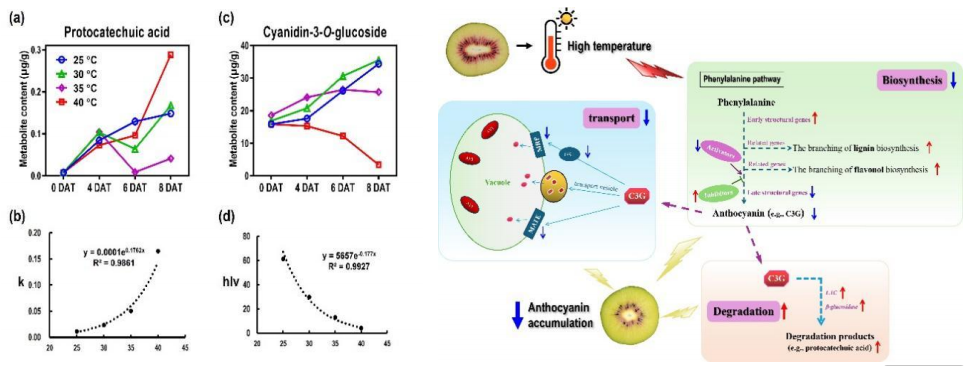
Kinetic analysis of anthocyanin degradation in living tissue and working model of high temperature regulated anthocyanin accumulation in kiwifruit (Image by CHEN Qiqi)