Name:Liu Wenzhi
Tell:
Email:liuwz@wbgcas.cn
Organization:Wuhan Botanical Garden
Plant Diversity Impacts Soil Nitrogen Cycling in Complex Ways, Global Study Finds
2026-03-13
Soil nitrogen (N) is crucial for sustaining ecosystem processes and functions, and plants play a significant role in influencing soil N availability and transformation processes. Yet, even as biodiversity declines, our understanding of how plant diversity impacts soil N cycling is limited, making it difficult to predict terrestrial N pools and transformations globally.
To address this knowledge gap, researchers from the Aquatic Ecosystem Processes Group at the Wuhan Botanical Garden, Chinese Academy of Sciences, undertook a global meta-analysis. They synthesized data from paired observations of plant mixtures and corresponding monocultures to assess how plant diversity affects soil N pools and N transformations over the long-term.
The study demonstrates that plant mixtures strongly influence soil N pools and dynamics, with the effects on total N and on N transformation rates (mineralization, nitrification, and denitrification) shifting from negative to positive over time. However, their impacts on soil nitrate (NO3-) - N content and N2O emissions remain consistently negative.
These findings suggest that maintaining plant diversity can contribute to long-term sustainability in soil N cycling and potentially mitigate climate change-related risks by reducing N₂O emissions. Researchers emphasize the need for long-term studies to fully understand these complex interactions.
This research was funded by the National Natural Science Foundation of China. The relevant results have been published in Journal of Applied Ecology entitled "Temporal shifts in soil nitrogen cycling responses to plant diversity across global terrestrial ecosystems".
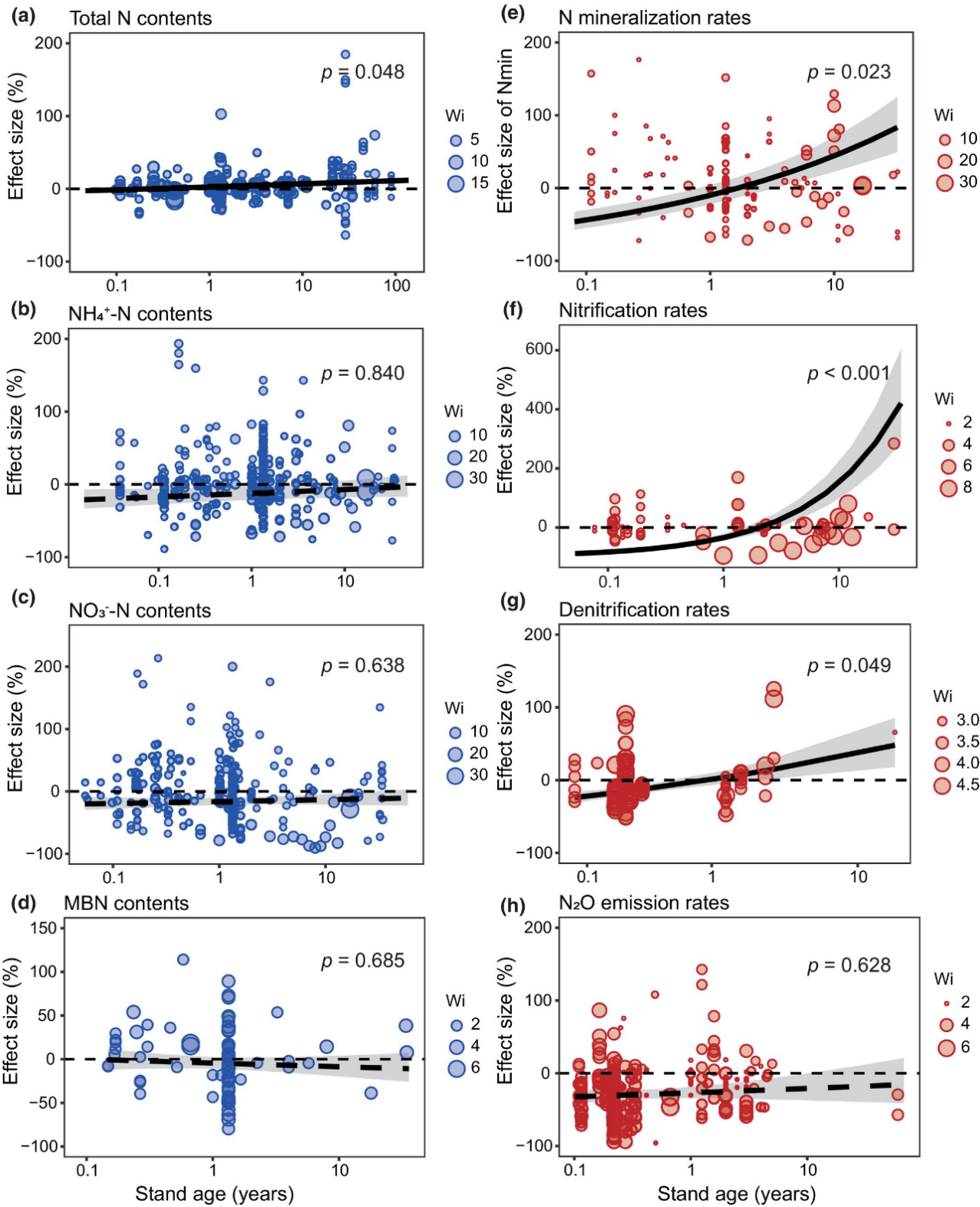
Plant mixture effect size of soil N pools and transformation rates in relation to stand age across diverse ecosystems (Image by WBG)