Name:CHEN Jinming
Tell:
Email:jmchen@wbgcas.cn
Organization:Wuhan Botanical Garden
From Land to Water: Expansin Gene Loss Helps Plants Thrive in Water
2026-04-27
When flowering plants returned from land to water, they faced a world of moving currents and shifting forces. Instead of developing stronger tissues, many aquatic plants simplified their body structures-reducing roots, losing stems, and forming thin, soft leaves-a shift now linked to the widespread loss of expansin (EXP) genes.
Expansins are cell wall proteins that loosen plant cell walls to enable growth, playing essential roles in root, stem, and leaf development in terrestrial plants. In aquatic environments, where buoyancy reduces the need for rigid support and water flow favors flexibility, retaining these genes may no longer be advantageous.
To understand this phenomenon, the Aquatic Plant Biogeography Group at the Wuhan Botanical Garden, Chinese academy of Sciences and the VIB-UGent Center for Plant Systems Biology in Belgium conducted a comparative study. They analyzed 19 aquatic plant genomes, representing free-floating, submerged, floating-leaved, and emergent life forms, alongside 9 terrestrial plant genomes.
Their findings paint a clear picture: submerged and free-floating aquatic plants have significantly fewer EXPA and EXLA expansin genes than their terrestrial relatives. The loss of EXPA genes, known to promote root hair development and leaf expansion in land plants, correlates with the reduced root systems and thin, structurally simple leaves observed in submerged and free-floating species.
Similarly, the loss of EXLA genes, which regulate hypocotyl formation in Arabidopsis, is mirrored by the absence of upright stems in free-floating plants. In contrast, emergent and floating-leaved plants-which still experience aerial conditions, retain an expansin repertoire, similar to that of terrestrial plants.
Further analysis, using synteny network analysis, researchers identified 15 conserved expansin clusters across angiosperms, with many dating back to early-diverging lineages. Notably, clusters associated with root development were absent in free-floating plants, while those clusters linked to petal and anther formation were missing in other aquatic groups.
The study demonstrates that gene loss, often overshadowed by the focus on gene gain, can be a powerful driver of evolutionary adaptation. By shedding expansin genes, aquatic plants streamlined their mechanical organs to better cope with the demands of water-losing complexity to gain survival.
This work was supported by the National Natural Science Foundation of China and other funding agencies. The article, titled "Simplified mechanical organs in aquatic plants are associated with the loss of expansin genes", is published in Plant Physiology. Dr. ZHANG Yue from the Wuhan Botanical Garden is the first author, and Professor CHEN Jinming serves as the corresponding author.
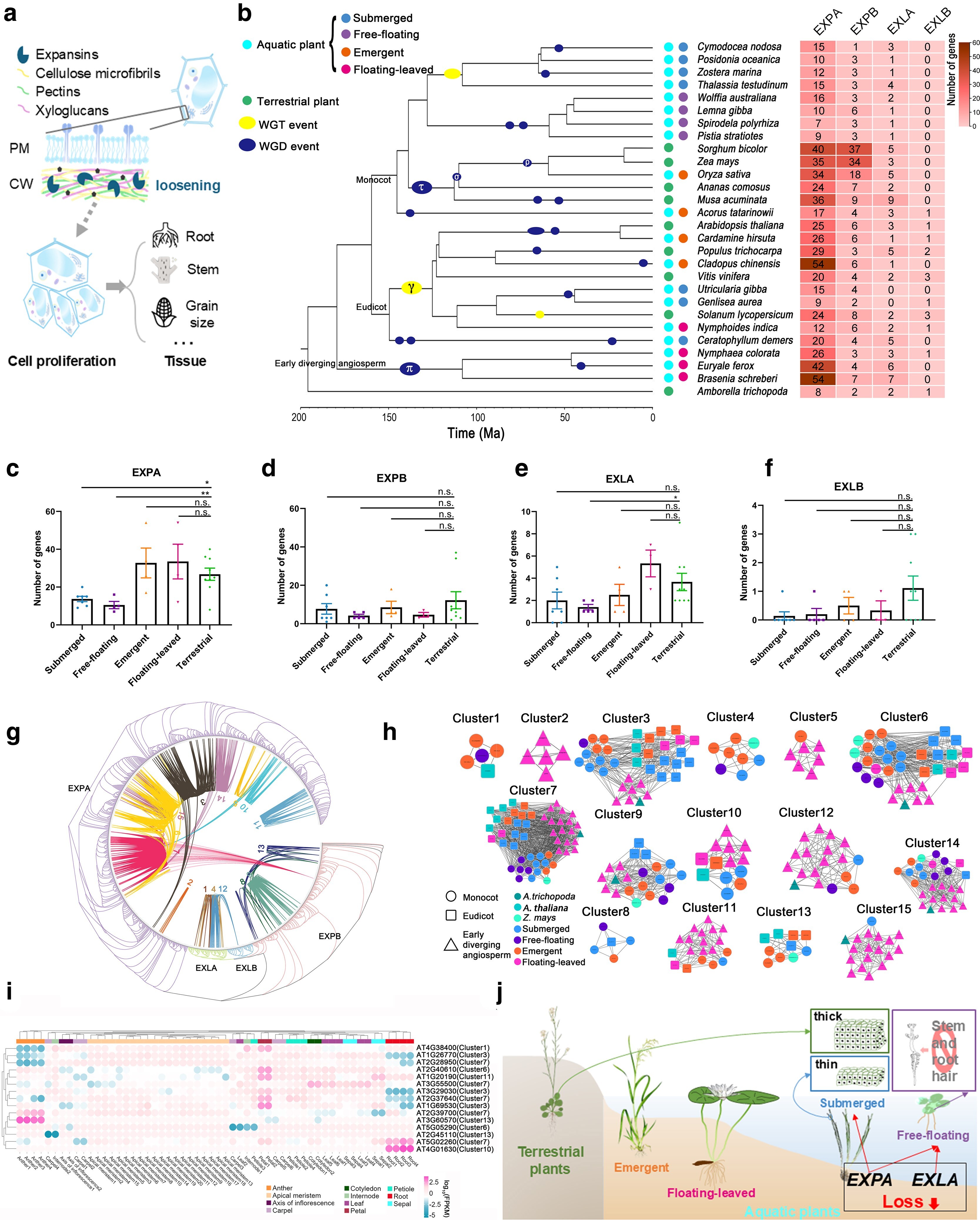
Phylogenetic investigation and synteny network-based clusters of expansin gene families in aquatic angiosperms (Image by WBG)