Name:HU Guangwan
Tell:
Email:guangwanhu@wbgcas.cn
Organization: Wuhan Botanical Garden
Another New Impatiens Species Discovered from Western Qinghai-Tibet Plateau
2026-05-06
Researchers from the Wuhan Botanical Garden of the Chinese Academy of Sciences have discovered a new species of Impatiens during a plant diversity survey in Zayu County, Xizang, China. The species has been named Impatiens zayuensis S. Peng, G. W. Hu & Q. F. Wang (Fig. 1). The study was recently published in the international plant taxonomy journal Phytotaxa under the title "A new species ofImpatiens(Balsaminaceae) from southeastern Xizang, China".
The genus Impatiens belongs to the family Balsaminaceae. There are over 1,000 species worldwide, and more than 300 species have been recorded in China. These are mainly distributed in the mountainous areas of southwestern China, with the highest diversity found in Yunnan, Sichuan, Guizhou, and Xizang.
In 2017, a research team led by Associate Professor CONG Yiyan from Hunan Normal University encountered a spurless Impatiens plant during a field survey of plant resources in Zayu County, Xizang. They took photographs at the time but did not collect any specimens. After discussions with the research team of Professor HU Guangwan from the Wuhan Botanical Garden, they preliminarily inferred that the plant might represent an undescribed species of Impatiens. In 2024, members of Professor HU's team revisited the survey site, carried out detailed investigations, and collected specimens. Through careful morphological comparison and molecular phylogenetic analysis, the plant was finally confirmed as a new species.
This new species belongs to I. sect. Racemosae Hooker & Thomson of subgenus Impatiens. It is morphologically similar to I. margaritifera Hook.f. (Fig. 2) and I. casseabriae Y.H.Tan, S.S.Zhou & B.Yang. However, I. zayuensis differs from the latter two in upper stem with glands, ovate lateral sepals, dentate margin of lateral sepals, sub-dolabriform or oblong lower petal, and oblique mouth of lower sepal. Phylogenetically, I. zayuensis does not cluster with the two morphologically similar spurless species, suggesting that the spurless character may have evolved several times within the I. sect. Racemosae. (Fig. 3). The discovery of this new species not only enriches the species diversity ofImpatiens in Xizang, but also provides new material for studying the evolutionary history, adaptive radiation, and biogeographic patterns of the genus on the Qinghai-Tibet Plateau.
YUAN Taohua, a doctoral student jointly trained by the Wuhan Botanical Garden and Xizang University, is the first author. The research was conducted under the supervision of Prof. WANG Qingfeng, Prof. HU Guangwan, and Dr. PENG Shuai, with participation from doctoral student HU Tian, Associate Professor CONG Yiyan from Hunan Normal University, as well as staff members from the Central South Academy of Inventory and Planning of NFGA and the Zayu Forestry and Grassland Bureau of Xizang. The study was financially supported by the Science and Technology Major Project of Xizang, the Second Tibetan Plateau Scientific Expedition and Research Program, the National Natural Science Foundation of China, etc.
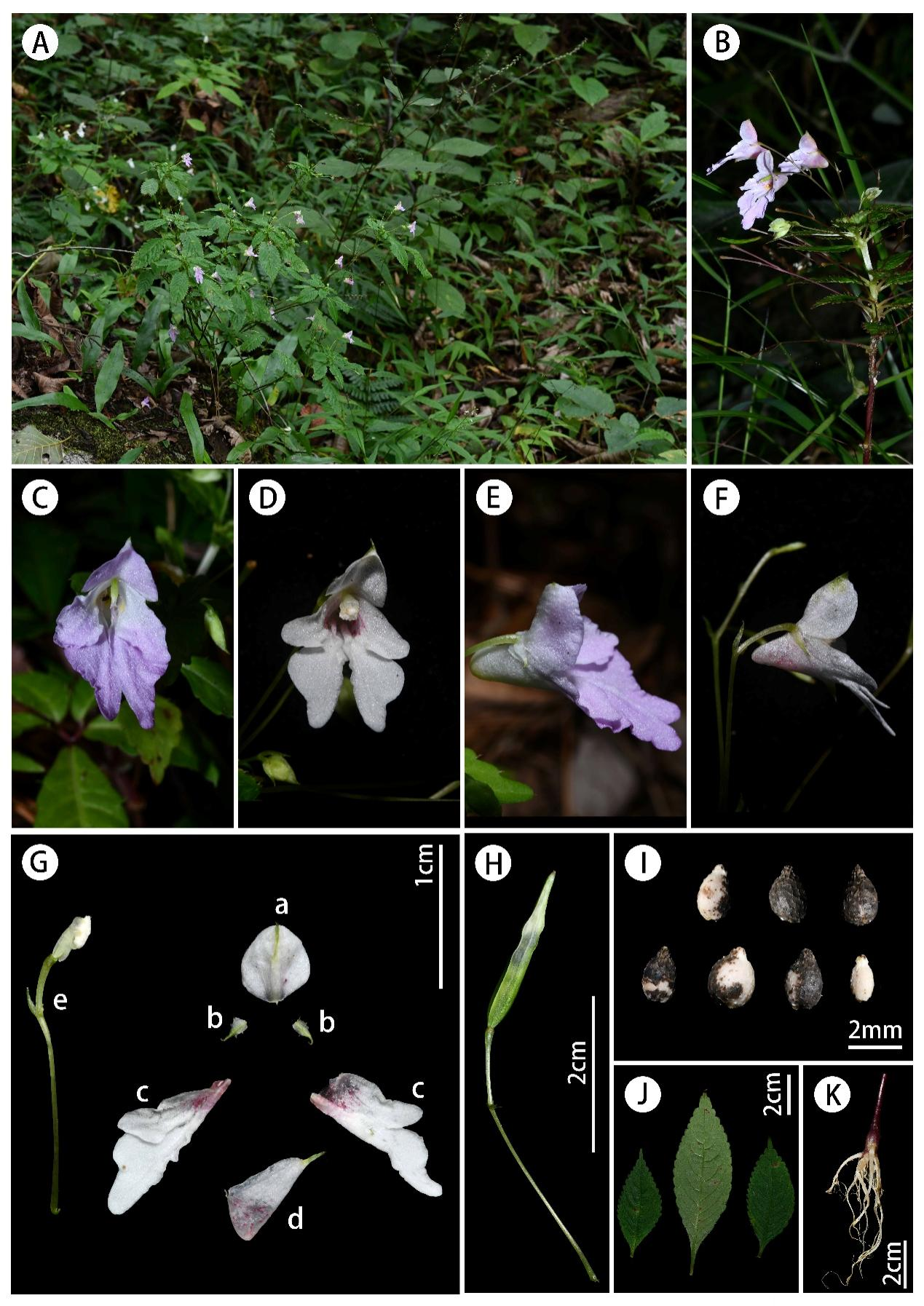
FIGURE 1. Impatiens zayuensis. A. habitat; B. inflorescence; C-D. front view of flower; E-F. lateral view of flower; G. dissected flower (a. dorsal petal; b. lateral sepals; c. lateral united petals; d. lower sepal; e. stamens and pedicel); H. capsule and fruit stalk. I. seeds; J. leaves; K. root (Image by YUAN Taohua)
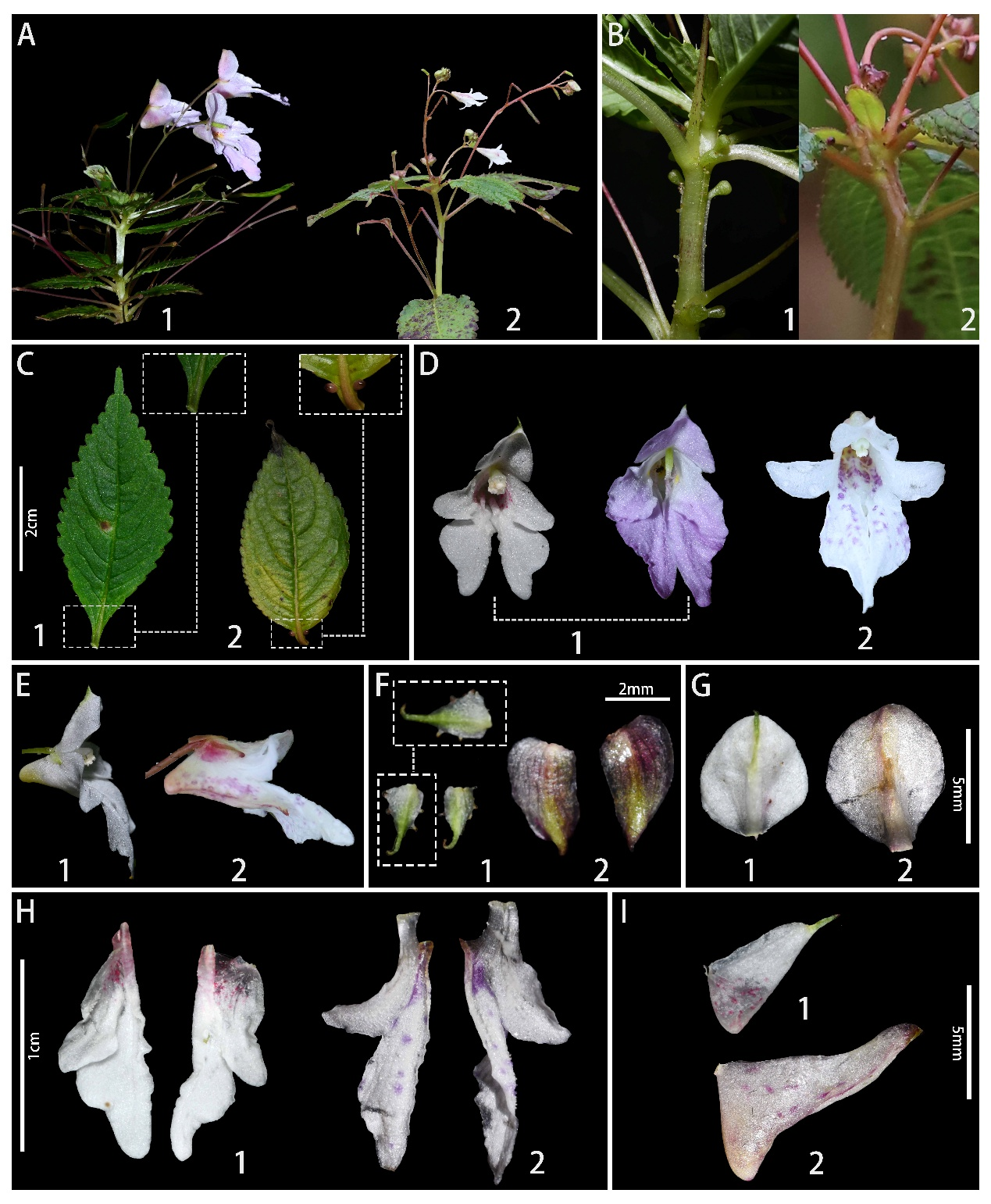
Figure 2. Morphological comparison of Impatiens zayuensis (A1-I1) and I. margaritifera (A2-I2). A. inflorescences; B. the upper part of the stems (showing glands); C. leaves (showing glands at the base of the leaf blade); D. front view of flowers; E. lateral view of flowers; F. lateral sepals; G. dorsal petals; H. lateral united petals; I. lower sepals (1-I1 photographed by YUAN Taohua; B2-E2 by HUANG Wen; F2-I2 by PENG Shuai)
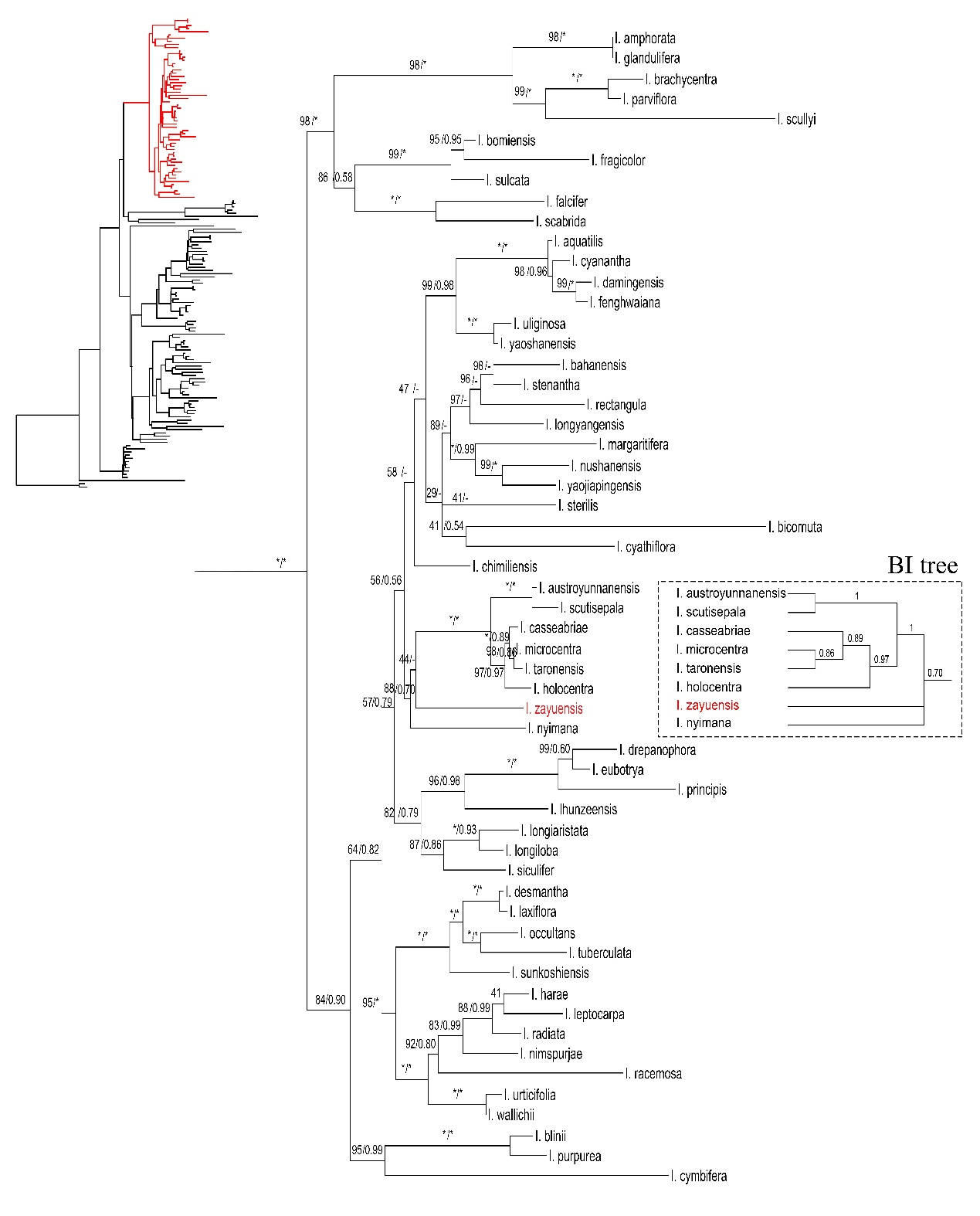
FIGURE 3. The phylogenetic tree based on a combined dataset of nrITS and plastid atpB-rbcL DNA sequences. The bootstrap percentages (BP) for maximum likelihood (ML) and posterior probabilities (PP) of Bayesian inference (BI) are shown in the branch (BP/PP, the dash [-] indicates a conflicting branch between ML and BI trees, and the asterisk [*] indicates BP=100 or PP=1.00) (Image by YUAN Taohua)