Name:CAO YU
Tell:
Email:caoyu@wbgcas.cn
Organization:Wuhan Botanical Garden
Rosette-forming Community Structure Optimizes Spatial Configuration in Lake Restoration
2026-05-12
A new study of the Wuhan Botanical Garden, Chinese Academy of Sciences, offers a promising strategy for restoring diverse and resilient submerged plant communities in eutrophic lakes. The research addresses a common challenge in lake restoration: the tendency for submerged plant communities to become dominated by a single species, which can compromise the long-term health and stability of the lake ecosystem.
Published in the Journal of Environmental Management, the study found that plant height-based functional classification more accurately predicts plant growth responses to community structure and water depth.
Researchers categorized eight submerged macrophytes into "long species" (e.g., Myriophyllum spicatum, Potamogeton wrightii ), which can form surface canopies, and "short species" (e.g., Vallisneria spp.), which are distributed in the lower water column. Notably, P. maackianus, despite its morphological similarities to long species, exhibited response patterns characteristic of short species. This exception highlights the necessity of using ecological function rather than static morphology to guide species selection in restoration practice.
The study revealed that by creating a more uniform underwater environment, the rosette forming communities (ROs) buffers the stress of deep-water, minimizes plant biomass differences between depths, and reduces competitive imbalances between long-and short species. Consequently, the total biomass becomes more comparable across growth form, facilitating species coexistence.
In contrast, canopy-forming community structure (CAs) created "low light-low oxygen" microenvironments through intense vertical light competition, thereby significantly inhibiting the subsequent colonization of both long- and short-species. This inhibitory effect intensified with increasing water depth, whereas ROs demonstrated consistent environmental buffering capacity across depths.
These findings suggest prioritizing rosette-forming species as "foundation species" in restoration practice. By modifying microenvironmental conditions, these communities create a suitable habitat for neighboring macrophytes, offering a practical strategy to break through the bottleneck of monospecific dominance and improve plant diversity in eutrophic lakes. This research was supported by the National Natural Science Foundation of China.
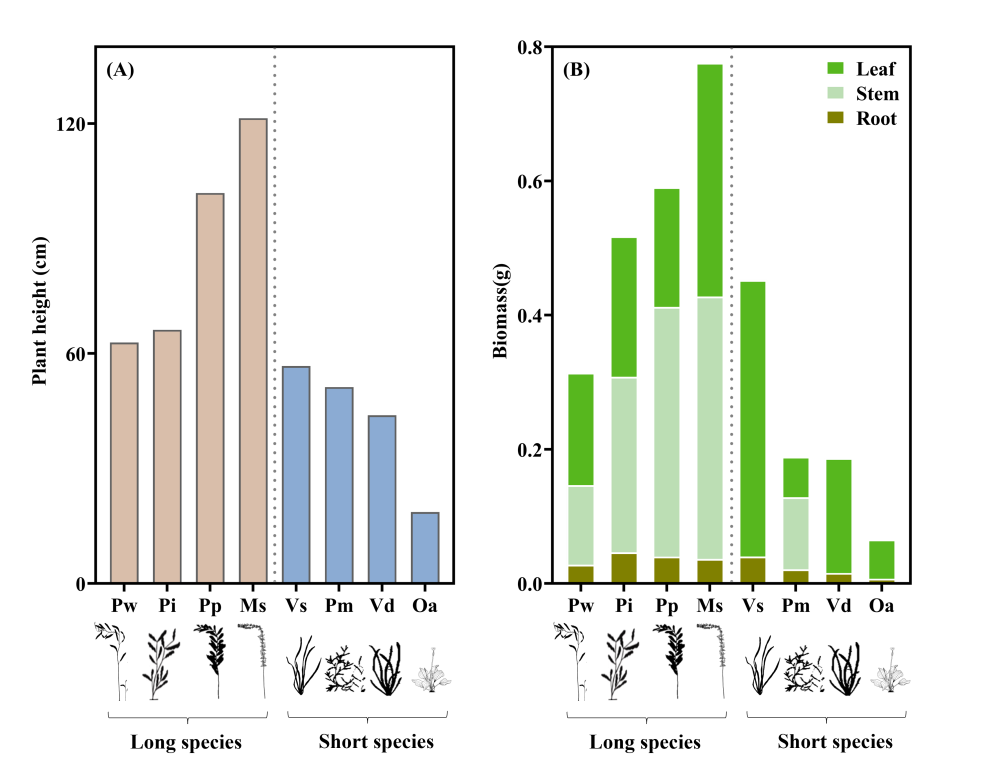
Plant height and biomass allocation characteristics of long and short species (Image by WBG)
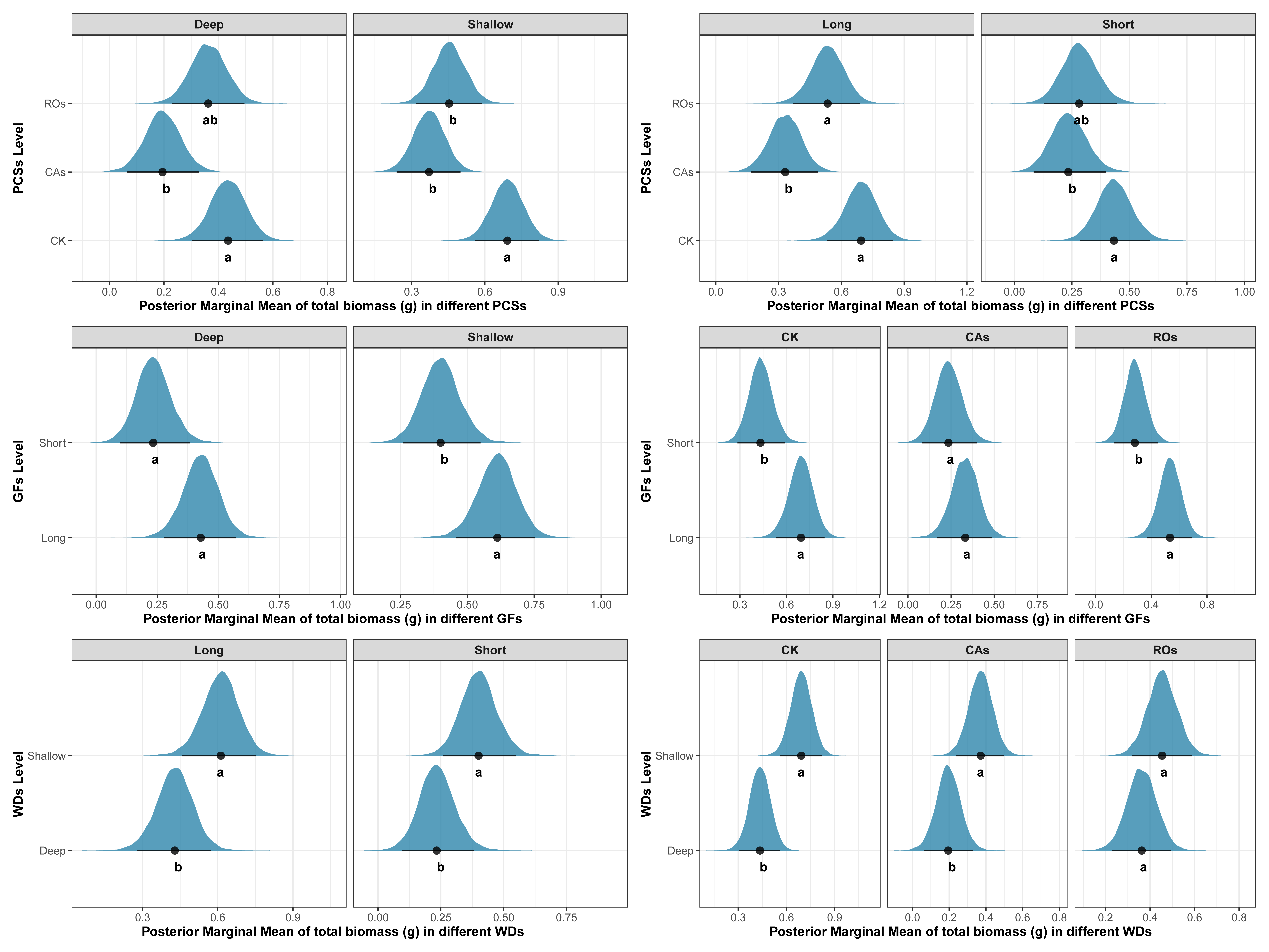
Effects of plant community structure, water depth, and growth form on plant growth (Image by WBG)