Name:WANG Qingfeng
Tell:
Email:qfwang@wbgcas.cn
Organization:Wuhan Botanical Garden
Study Traces the Origin of African Succulent Euphorbia Section Monadenium to Early Miocene
2026-08-28
Euphorbia section Monadenium comprises about 90 species restricted to tropical Africa, with its greatest diversity in East Africa. Its members range from geophytes and perennial herbs to succulent shrubs and small trees, and many are endemic to arid or seasonally dry habitats. However, their evolutionary and biogeographical history has remained poorly understood.
Researchers from the Plant Diversity and Evolution Group at Wuhan Botanical Garden of the Chinese Academy of Sciences have reconstructed a significant part of the evolutionary history of E. sect. Monadenium. The researchers analyzed 81 accessions, including 63 plastomes representing 56 species, which account for about 62% of the recognized species in the section.
Phylogenetic analyses strongly supported the monophyly of E. sect. Monadenium and identified eight major clades. Importantly, the results also showed that the formerly recognized genera Monadenium, Synadenium, and Endadenium did not from separate monophyletic lineages.
Divergence-time estimates indicate that crown diversification of E. sect. Monadenium began approximately 16.69 million years ago in the Early Miocene. Ancestral-range reconstruction suggests an origin in the Zambezian region, followed by repeated dispersal and vicariance across eastern, south-central, and southern Africa. Although its ancestral range was inferred to be in the Zambezian region, the study notes that present-day species richness is concentrated in East Africa, especially around the East African Rift. Changes in rainfall seasonality and precipitation during climatically stressful periods played important roles in shaping ecological differentiation within the section.
Ecological niche modeling further revealed fluctuations in suitable habitats, with contractions during the Last Glacial Maximum and expansions during the Middle Holocene. Presrent-day suitable are concentrated mainly in East Africa.
The findings suggest that late Neogene climatic drying, increasing rainfall seasonality, and the heterogeneous landscapes of African jointly promoted the dispersal, isolation, and diversification of this succulent lineage.
The findings were published in Palaeogeography, Palaeoclimatology, Palaeoecology, a leading journal in palaeontology, under the title "Miocene origin and African biogeographical history of the predominantly East African succulentEuphorbiasectionMonadenium". Associate Professor WEI Neng and PhD candidate RAN Zhaohui from Wuhan Botanical Garden are co-first authors, while Professor WANG Qingfeng and Associate Professor WEI Neng are co-corresponding authors. Researchers from the Royal Botanic Gardens, Kew, the National Museums of Kenya, the University of Antananarivo, and the University of Zimbabwe also contributed to the study.
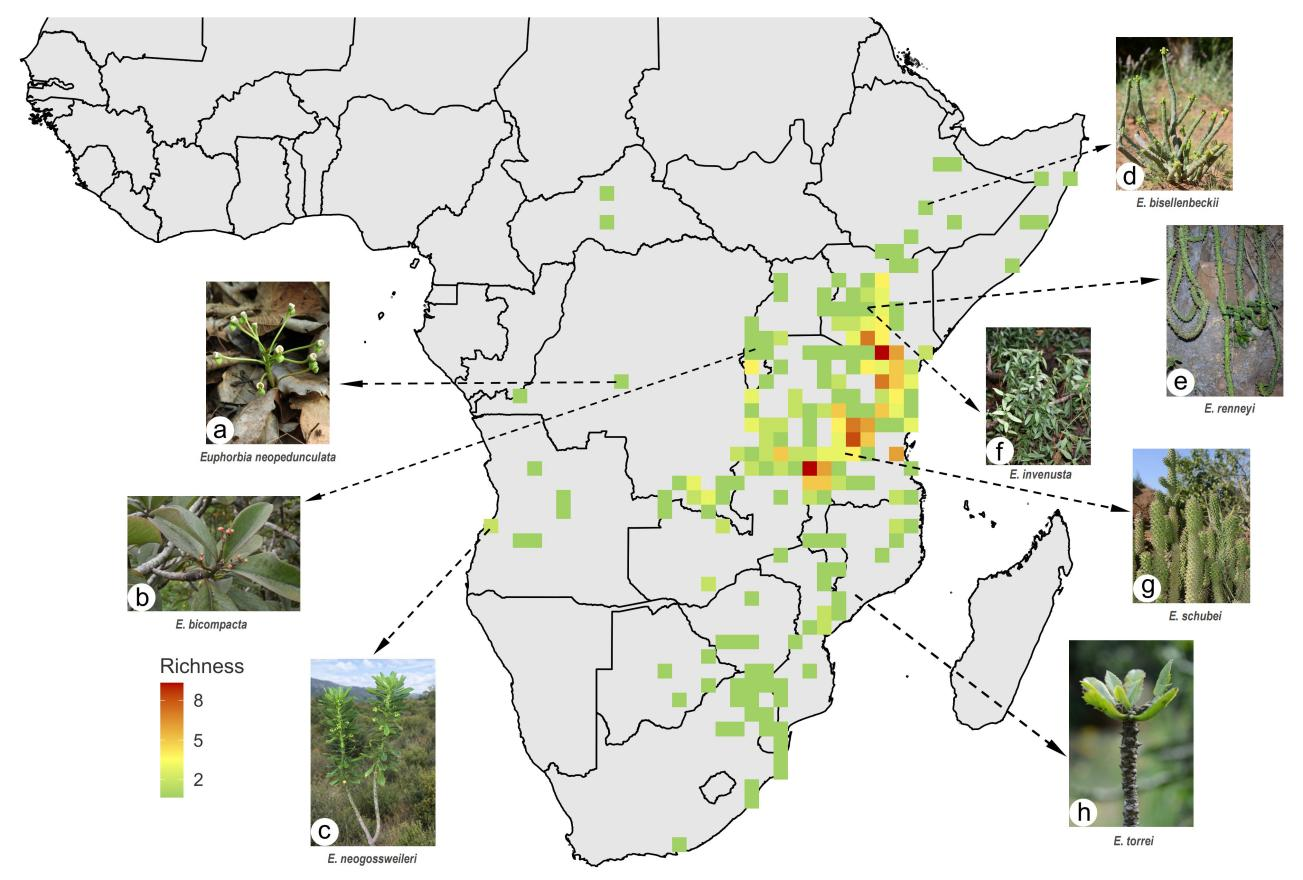
Species richness pattern of Euphorbia sect. Monadenium across Africa based on 100 km × 100 km grid cells (Image by WBG)
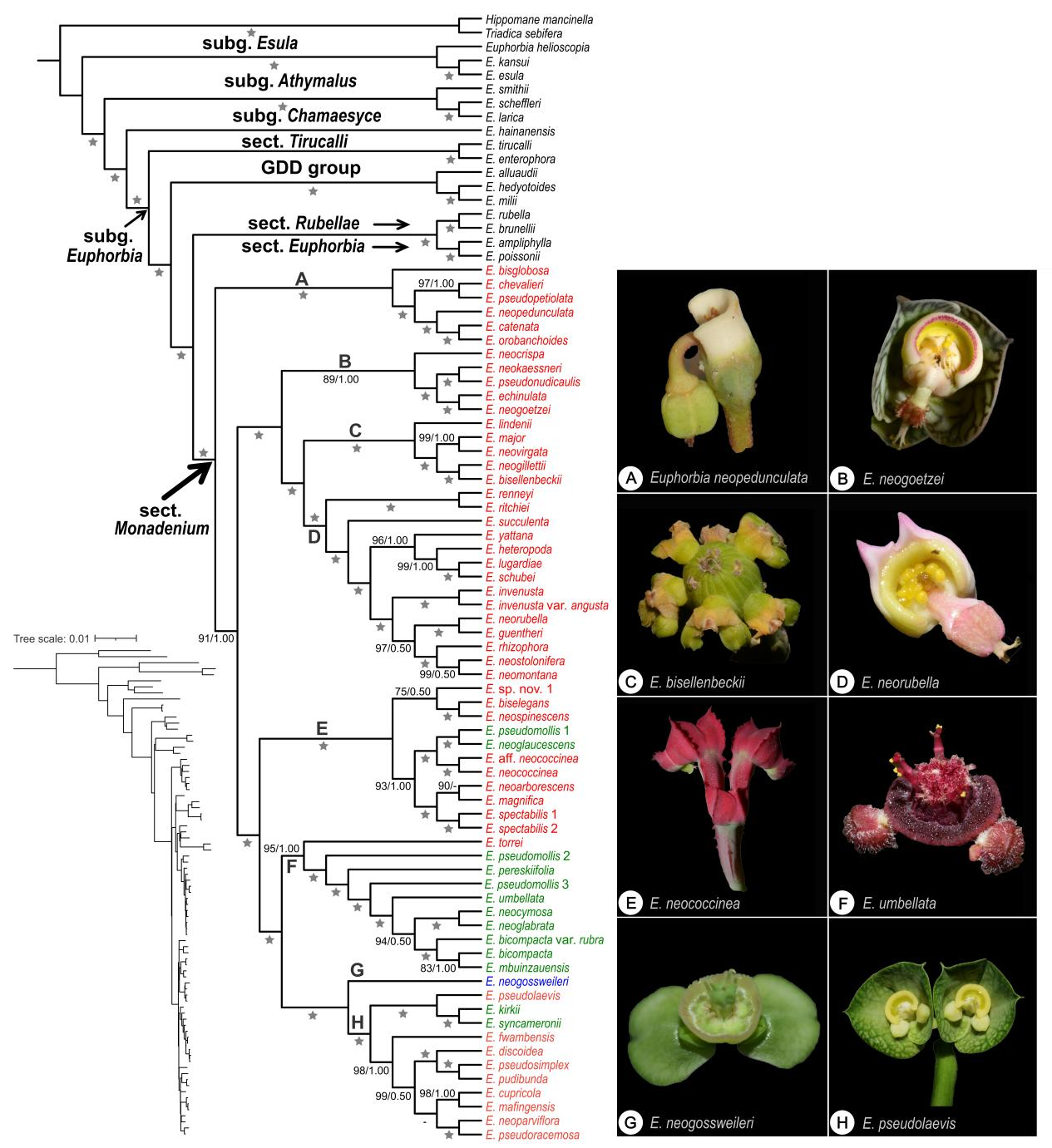
Maximum likelihood (ML) phylogeny of Euphorbia sect. Monadenium inferred from the complete plastome dataset (Image by WBG)